








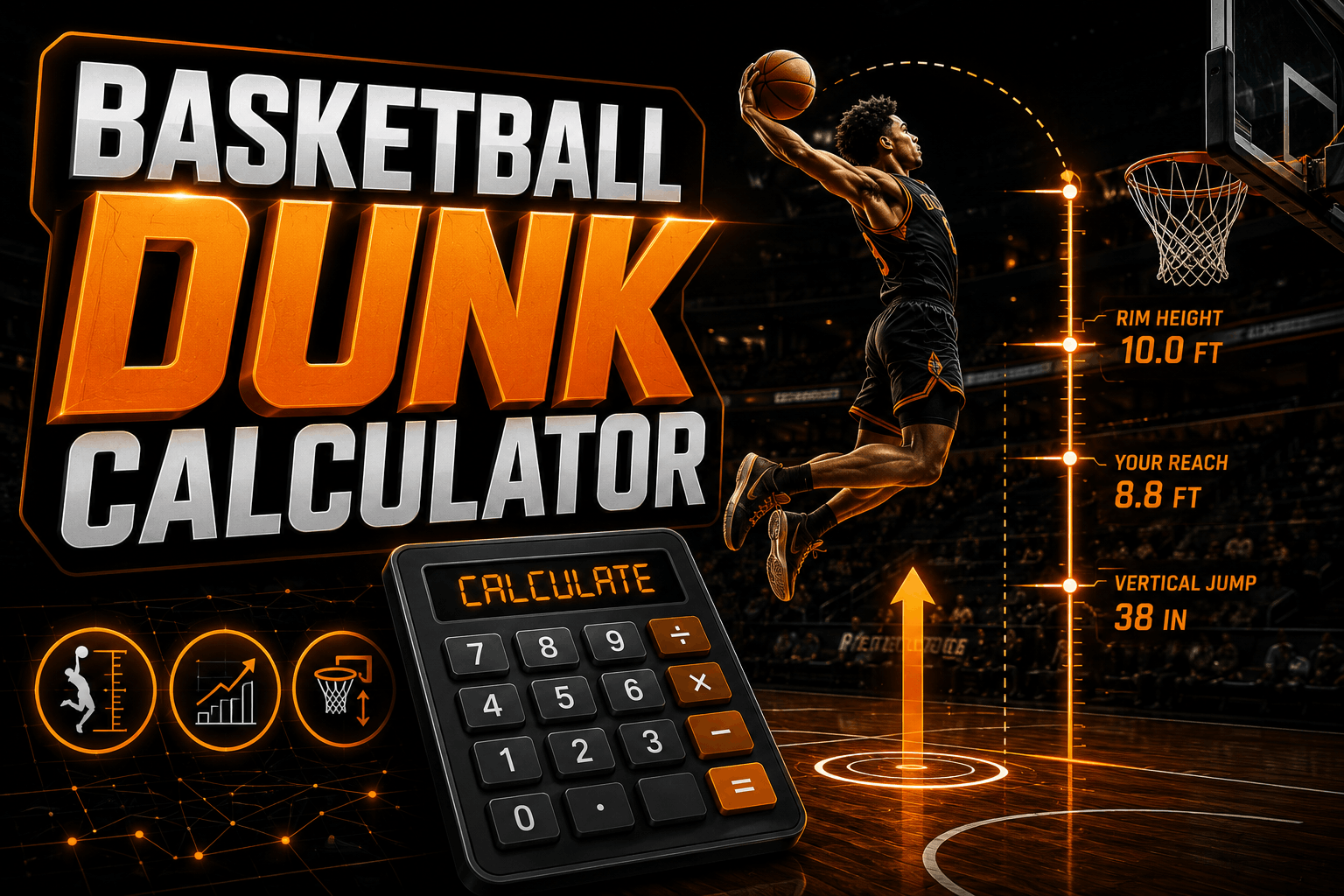
Wondering whether you can jump high enough to dunk a basketball? Well, now you’ve got an easy way to determine that. See how close you are to your selected dunk goal by calculating your vertical jump needed to clear the rim with our easy to use and completely free dunk calculator.
Dunk Calculator
What is Dunk calculator and how does it help you determine the Dunk clearance?
A basketball dunk calculator is a free to use tool which allows basketball players to estimate how high vertical jump they need to dunk on a standard 10-foot rim. It’s an useful part of vertical jump training and it works by taking into account the rim height, your standing height and several other metrics. The calculator offers you a quick and easy to use way to get accurate dunk potential results.
How to use the Dunk calculator to estimate basketball dunk potential: A detailed breakdown on how our Dunk calculator works
Dunking a basketball requires you to jump high enough so as for your hand to reach 6 inches above the rim on a clean dunk and 8-10 inches for two-hand dunk. To be able to do so, most players need a vertical jump of min 28-34 inches. Of course, that’s highly determined by your height, too, which is why tall players can dunk more easily whereas short players require a very high vertical jump to dunk on a 10-foot rim.
But you don’t have to start random guessing those numbers. Actually, the easiest way to test your vertical jump height and determine the vertical jump needed for you to be able to complete your first dunk is to use a free online calculator. And if you’re planning on doing so, you’ll need to be more aware of what factors determine how high you’ll have to jump to be able to dunk.
Your height
First step in calculating whether your current vertical leap is enough to dunk a basketball is to input your height. It directly correlates to your standing reach and the taller you are, the less vertical jump you need and vice versa. Of course, more exact data you’ll get when you use our free dunk calculator by inputting your standing reach but if you’re not sure how much that is, you can go with height only.
Standing reach
Another quite an important factor that detemines your ability to dunk is your standing reach. That’s the height you can reach by stepping with your both feet at the ground and reaching your hand up. To estimate your standing reach, you can multiply your height times 1.33. That’s the average standing reach and something you can use if you don’t want to take the exact measurement right now. Of course, it’s always better to input accurate data to make a full use of the advantages the calculator gives you. But do remember also that the standing vertical reach is shorter than the one with one or two steps approach and the running jump is commonly higher than a standing one.
Rim Height
The standard basketball rim height is 10-foot. And that will be the setting which is automatically turned on. But if you’d like to do the calculations with 8-foot or 9-foot rims, you can also make use of the dunk calculator features, you’ll simply need to toggle this setting.
How to use our dunk calculator to see the required vertical jump: Detemine how high do you need to jump to dunk and improve your basketball performance
To use our free funk calculator feature, you will simply need a few metrics and a couple of minutes. Just enter your height and standing reach, choose the approach type (whether it’ll be a standing jump or one/two step approach) and confirm the calculations.
And once you input all the required information, our calculator instantly determines several targets:
- how much inches of vertical jump you need to touch the rim
- how high you need to jump to dunk a basketball
The calculator also includes insights on whether your current vertical jump is enough to reach your dunk goal or you’ll have to jump higher, provided you’ve input those metrics, of course.
Advantages of using out vertical calculator: How our free dunk calculator helps you improve your vertical jump
There are many ways in which our free tool can help you with. For instance, you can calculate how much of a jump height you need on different dunk types. Because it’s one thing to perform a slam dunk, another to succeed with a two-hand dunk and a completely different vertical jump height is needed for a 360° windmill. With our free to use tool, though, it’s easy to estimate how high you need to reach for all those different dunk styles and determine how much of a jump is enough for you to touch the rim or perform a clean dump shot. And when you know all those metrics, then you can decide how to continue with your dunk training so as to hit your vertical jump target.
Getting the exact measurements for the exact vertical jump you need to finish a dunk is also pretty useful for tracking your progress during training knowing how your current jump compares to you sufficient vertical.
You can use a dunk calculator to determine whether you’ll need a 40 inch vertical or just about 25-30 inches to dunk. Or you can also use it to determine who has the highest potential on the next NBA dunk contest. Or how probable it is for someone to perform a dunk shot on the next basketball game. Yes, the calculator includes multiple useful insights and the best part of using it is how easy and quickly you can get all the calculations you need. Which all make it quite an useful tool, especially considering you’re getting it completely for free.
Vertical Jump Standards
| Category | Vertical Range | Description |
|---|---|---|
| Average Male | 16–20 inches | General population, untrained |
| High School Athlete | 20–24 inches | Trained high school basketball player |
| College Player | 24–28 inches | NCAA Division I average |
| NBA Average | 28–32 inches | Professional basketball player |
| NBA Elite | 32–40 inches | Top dunkers and athletes |
| Legendary | 40+ inches | Michael Jordan, Vince Carter |
NBA Vertical Jump Reference
| Player | Vertical Jump |
|---|---|
| Michael Jordan | 48″ vert |
| Zion Williamson | 45″ vert |
| Zach LaVine | 46″ vert |
| Vince Carter | 43″ vert |
| Russell Westbrook | 36″ vert |
| LeBron James | 40″ vert |
| Average NBA | 28″ vert |
| Steph Curry | 30″ vert |